

Why Reverence Cannot Be Programmed
On the ancient posture the modern world no longer knows how to teach

The Cogitating Ceviché is a reader-supported publication. To receive new posts and support my work, consider becoming a free or paid subscriber.
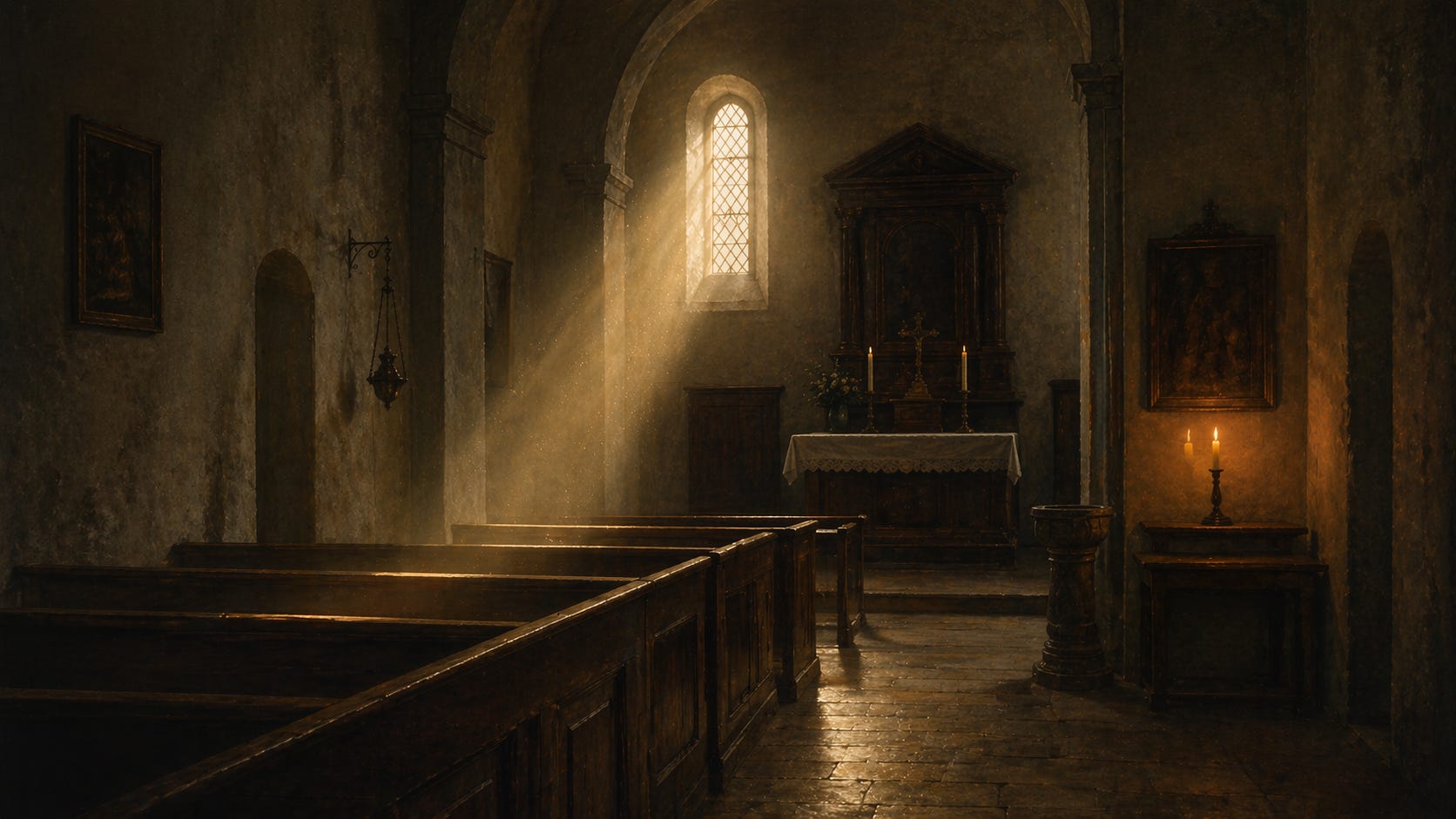
A person steps into an old church. Something shifts before thought catches up. The voice lowers. The step slows. The hands fold without being told. Whatever was said in the parking lot is no longer said here. This response, once the ordinary schooling of the soul, has grown rare. It has not grown rare by accident.
Contemporary culture is fluent in production. It knows how to design an experience, pace a room, calibrate a sequence of lights and sounds to move an audience from distraction to tears. It can manufacture wonder for a weekend festival and engineer awe for a product launch. It can prepare a space to feel momentous. There is real craft in this, and it is not dishonorable in every form. But reverence, the particular posture a creature takes before what is holy, does not submit to this process. It cannot be produced. It can only be received.
Christianity has always known this. Reverence, in the biblical grammar, is never the outcome of technique. It is the response of a creature who has seen something he did not invent and cannot manage. When Moses turns aside in Exodus 3 to look at the bush that burns without being consumed, the first word from the fire is not instruction. It is a command about his shoes. Before the vocation, before the message, before anything Moses will be sent to do, there is the hallowing of ground. Reverence comes first because it allows the rest to follow.
Isaiah sees the Lord high and lifted up, and the seraphim cover their faces. Habakkuk, having spoken his complaint into the whirlwind, ends in a hush: “The Lord is in his holy temple; let all the earth keep silence before him.” In the Revelation to John, the opening of the seventh seal produces silence in heaven for about half an hour, a detail so strange that commentators have circled around it for centuries. Heaven itself, apparently, knows when to stop speaking.
Reverence is the word for this. It is not a mood. It is not an aesthetic. It is the recognition that one is in the presence of something greater than oneself, followed by the instinct to become smaller. It begins where control ends.
Because it is a response, this posture cannot be engineered. The machinery of production can clear room for reverence or close the room against it, but it cannot summon the thing itself. You can build a sanctuary of vaulted ceilings and leaded glass and practice the old hymns in four-part harmony and still find, among the worshipers, only spectators. You can strip the room bare and find, in the corner, someone weeping because he has understood.
This is why the modern attempt to manufacture the sacred tends to produce something else entirely. Emotion, it turns out, can be summoned. Reverence must be learned. The two are easily confused because they can occupy the same body at the same time, and a person moved to tears by a skillful worship set may mistake his own stirred feeling for the touch of God. The feeling is real. Whether it has formed anything is a separate question.
Manufactured awe has a structural problem, and it is visible in the arc of its own escalation. Each iteration must exceed the last. What moved the room in January will not move it in June. The lights must be brighter, the builds longer, the low end deeper, the transitions more seamless. Novelty is required because depth has not been offered. Before long, the congregation has been trained to evaluate rather than to receive, and the worship service becomes a performance to be reviewed. This is not the moral failure of any individual. It is the natural result of a grammar that has forgotten the difference between emotion and formation.
The older Christian tradition understood that reverence is cultivated slowly. The Desert Fathers gave it the name hesychia, the stillness of heart that comes only after long silence. Their cells were empty rooms where nothing was engineered because something was expected. Augustine, who knew as well as anyone how loud the interior can become, opened his Confessions with the line that remains the whole diagnosis: our hearts are restless until they rest in God. The restlessness is not cured by stimulation. It is cured by being brought, over time, into a posture the soul did not choose.
The monasteries kept the hours because they knew that the soul needs the same shape applied to it again and again before it takes the shape. The cathedrals were built on a timescale no marketing committee could tolerate, because their purpose was not to impress a visitor on a Tuesday but to form a community across generations. A child born into the shadow of a cathedral learned reverence without being instructed in it. The stones had already done the catechesis.
This is what children still learn, for better or for worse. They are acutely sensitive to the question of whether the adults in the room treat anything as set apart. They notice whether voices lower near the altar. They notice whether the meal begins with a prayer or a phone. They notice whether their grandmother crosses herself when she passes the church, or whether no one bothers. They notice whether the adult at the door removes his hat before stepping into the sanctuary, and whether anyone still teaches them to do the same. When everything feels casual, nothing feels sacred, and a child raised in a world of uniform informality will struggle, as an adult, to locate the weight of anything at all.
Reverence is not transmitted by explanation. It is transmitted by atmosphere shaped by restraint. The restraint is doing real work. It is teaching the child that some things do not submit to the ordinary currency of attention, that some words are not said casually, that some moments ask for the body to arrange itself differently. These are not arbitrary manners. They are the first lessons in a grammar the soul will need if it is ever to stand before God without flinching. And the first word in that grammar, the one the modern ear has most difficulty hearing, is silence.
Silence is the teacher that most modern rooms have dismissed. It has always been essential to reverence, because the posture needs room to settle. Not the awkward silence of a group that has lost track of its script, but the intentional silence of a community that has agreed to stop speaking because something worth attending to is present. Silence of this kind is uncomfortable at first. It is often filled too quickly. A worship leader reaches for the transition. A priest moves on to the next movement. An audience assumes that nothing is happening because nothing is being produced.
Silence cannot be programmed, because it cannot be controlled. It demands trust. Trust that the Spirit will meet the room even when no one is speaking. Trust that the silence itself is doing the work that words cannot. Trust that the congregation will bear the weight rather than panic into chatter. The old liturgies knew how to hold this silence. The newer ones often do not.
Reverence also acknowledges a hierarchy the modern soul finds difficult. Not a hierarchy of persons, but an ordering of reality in which God is not negotiable, not editable, and not subject to preference. This is the quiet offense of hallowing in an age of customization. Everything else has been made adjustable. The music in the ear is tuned to the listener. The content in the feed is sorted by taste. The news is delivered in the voice the reader already prefers. Under these conditions, the inner life forgets that anything could simply be what it is and require the self to conform.
Reverence is the refusal to treat God as a user experience. It is the stubborn claim that there is a reality before which the appropriate posture is not critique but hush. This sounds severe, and it is often misread as such, but it is actually the most liberating claim in the Christian grammar. A God one could customize would not be a God one could trust. A holiness one could tailor would not be a holiness that could save. Reverence, rightly understood, is the soul’s relief at discovering that something is finally not about it.
Recovery, when it comes, will be slow. It will look like the rebuilding of small habits that the last century quietly abandoned. The prayer before the meal, said without performance. The Sunday morning treated differently from the Saturday night. The sanctuary kept plain because the plainness is part of the lesson. The repeated practice, the protected silence, the unhurried liturgy that does not apologize for taking its time. Children raised in these habits will know something their catechists cannot tell them. They will have been formed, not merely informed.
The habits have tangible anchors, and that is part of their wisdom. The weight of a prayer book handled every week until its spine softens. The cool of a stone floor under a child’s stocking feet. The candle that flickers not because the building lacks electricity but because fire is the oldest reminder that something is being given. The worn knee of a kneeler. The simple bread broken with the same words used for two thousand years. These are not relics. They are instruments of formation. The body learns reverence by participating in gestures it did not invent, and the soul follows where the body has already bent.
None of this will produce immediate results, and that is part of the point. Reverence is not a program with a quarterly report. It is the long labor of hallowing, and hallowing has always moved on a different calendar than production. The desert monks gave their lives to it. The cathedral builders gave generations to it. The mothers who have taught children to fold their hands at grace have given something too, something quieter but no less real. What these offerings share is not efficiency but fidelity, the willingness to do a small holy thing again, and then again, until it becomes the shape of a life.
A culture that cannot revere anything will eventually find obedience oppressive and authority arbitrary, because it has lost the posture from which such things make sense. This is not primarily a political problem. It is a spiritual one with political consequences. The soul that has never learned to bow before God will not know how to stand before anything else.
Christian faith does not depend on reverence as decoration. It depends on reverence as orientation, as the first gesture of the creature before the Creator, the small humility that precedes every real encounter. The gesture cannot be faked. It cannot be manufactured. It cannot be streamed. It can only be learned, slowly, in the company of those who have learned it, in rooms where something has been kept holy long enough for the holiness to teach.
Reverence cannot be programmed. It must be received, cultivated, and handed down. And where it is kept, quietly and without performance, the old hush is still doing its ancient work, teaching the soul how to stand before God.
Thank you for your time today. Until next time, God Bless.
Do you like what you read but aren’t yet ready or able to get a paid subscription? Then consider a one-time tip at:
https://www.venmo.com/u/TheCogitatingCeviche

Ko-fi.com/thecogitatingceviche

🙏🙏