The Cogitating Ceviché is a reader-supported publication. To receive new posts and support my work, consider becoming a free or paid subscriber.
Jewish scribes preserved the Hebrew Bible by fixing not only its words, but the way those words were to be read, sounded, copied, and guarded.
What Was at Risk
The Hebrew Bible did not arrive in the Middle Ages as a single untouched object. It had passed through scrolls, readers, teachers, copyists, communities, disputes, exile, and worship. Its letters had endured, but endurance is not the same as immunity. A copied text remains alive only by passing through human hands, and hands are never perfect.
The danger was not only that a word might be lost. The danger was that a word might survive without its voice.
Ancient Hebrew writing carried consonants. Vowels, pronunciation, chant, pauses, and interpretive rhythm lived in reading practice. A scroll could hold the letters, but not every breath required to speak them. The synagogue scroll bore the sacred consonantal text, but the fuller Masoretic codices served a different purpose: they recorded the letters together with signs, accents, marginal notes, and reading traditions meant to protect both copying and recitation. (The Society for Old Testament Study)
By the sixth through tenth centuries, Jewish communities were scattered across lands and languages. Hebrew was no longer the ordinary tongue of many Jews; Aramaic, Greek, and Arabic pressed around the text. Memory still lived, but it was stretched across distance. What had once been held by trained mouths and disciplined ears now needed marks.
The Masoretes worked in this gap. They were not prophets, apostles, kings, or lawgivers. They were scribes and scholars. Their task was not to add revelation, but to prevent inherited words from dissolving into uncertainty.
They treated the page as a place of custody.
The Custodian’s Charge
The name “Masorete” comes from a root associated with handing down. The Masorah itself became the body of notes and signs through which the biblical text was guarded. The work was not merely copying. It was transmission with restraint.
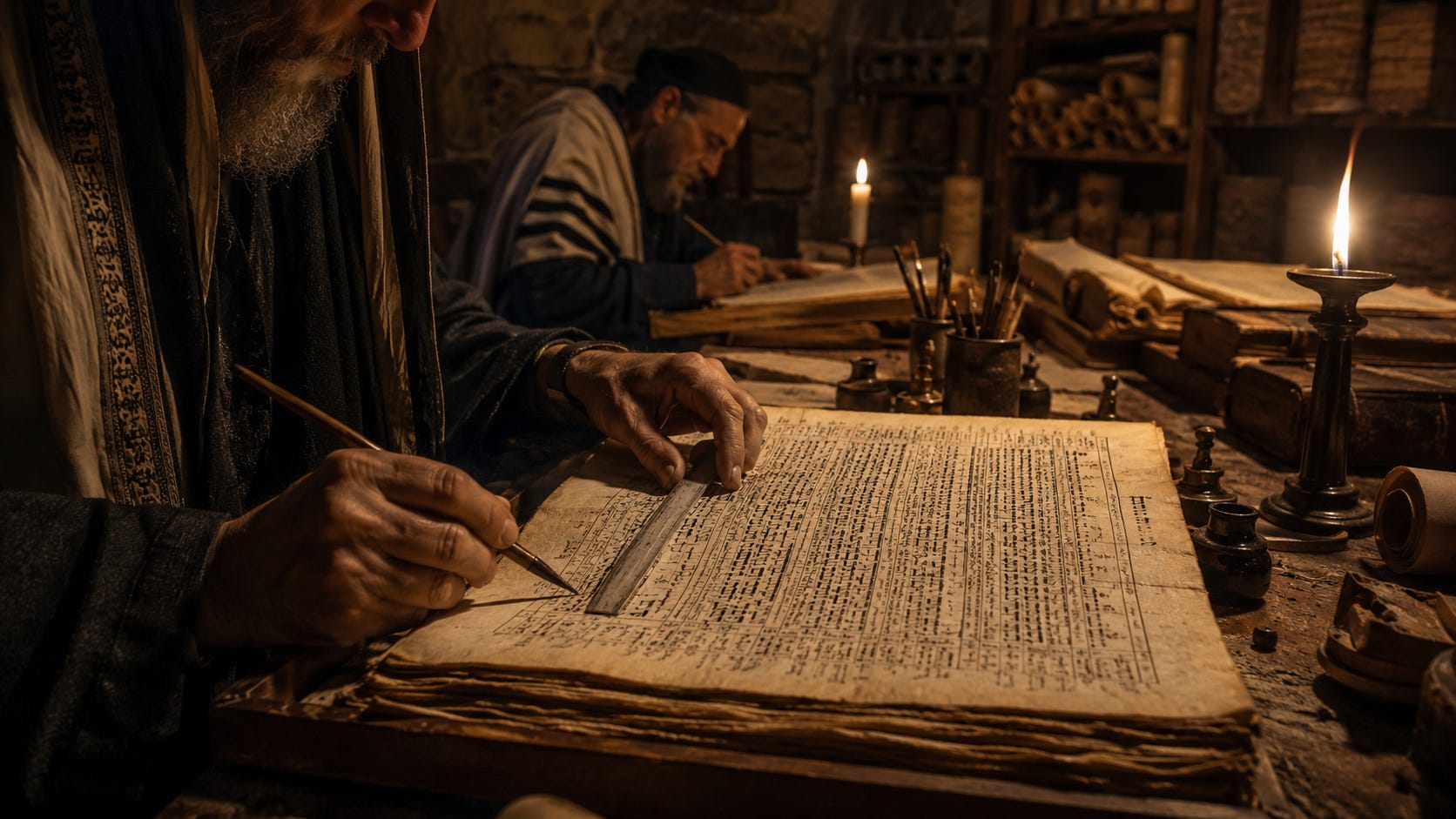
The Masoretes undertook to preserve the consonantal text, indicate pronunciation, mark accents and pauses, record unusual spellings, identify rare forms, and warn future scribes not to correct what only looked like an error. The Masorah included brief side notes, longer upper and lower marginal notes, and final collections of material that could not fit beside the text. (Jewish Encyclopedia)
This was a severe form of humility. A careless scribe might silently improve a phrase. A pious scribe might harmonize what seemed irregular. A learned scribe might smooth difficulty into clarity. The Masoretes’ discipline moved in the opposite direction. When the text was strange, they marked the strangeness. When a form appeared only once, they noted its rarity. When pronunciation mattered, they gave the reader signs. When the written form and the read form differed, they held the tension rather than pretending it did not exist.
Their fidelity was not the fidelity of simplicity. It was the fidelity of controlled complexity.
The Masoretic tradition developed in more than one center. Palestinian, Babylonian, and Tiberian systems existed, but the Tiberian system eventually prevailed. The schools associated with Ben Asher and Ben Naphtali produced slightly different forms of the Masoretic Text, with the Ben Asher line becoming the basis for later Hebrew Bibles. (TheTorah.com)
The Masoretes therefore did not merely preserve a text. They preserved a chosen form of it. That distinction matters. Their work was conservative, but not passive. To guard one tradition fully is to leave others less protected.
The Choices They Made
The Masoretes made their choices in signs so small that a reader might overlook their power.
They added vowel points. They added accent marks. They indicated how words should be divided, stressed, sung, and understood. These signs did not replace the consonants. They gathered around them like servants around a king, but servants can determine how a king is seen.
A sentence without vowels may permit more than one reading. A phrase without accents may lean in more than one direction. The Masoretic signs narrowed those possibilities. They did not invent the Hebrew Bible. They shaped the Bible that later generations would hear.
Hebrew manuscripts used for study differed from synagogue scrolls. The scrolls used in worship carried only letters. Masoretic codices were bound books for scholars and students, equipped with the apparatus needed to safeguard pronunciation, recitation, and copying. (USC Dornsife)
Their marginal notes also changed the nature of preservation. A text alone can be copied. A text surrounded by warnings can be defended against its copyists.
Here was one of their deepest acts of judgment. Future scribes would be tempted to correct the unusual, so they made the unusual visible. They counted occurrences. They marked anomalies. They built a fence not around meaning in the abstract, but around letters, sounds, and forms.
The Masoretes also inherited a world in which textual plurality had existed. Before the final dominance of the Masoretic line, Jewish scripture circulated in more than one textual form. The Septuagint, Samaritan Pentateuch, Dead Sea Scrolls, and other witnesses show that ancient Scripture had not always existed in one uniform version. The Masoretic Text became authoritative within organized Judaism. Older plurality had already narrowed. (Encyclopedia Britannica)
Their work therefore involved a paradox. They preserved by fixing. They protected by limiting. They transmitted by reducing the range of acceptable variation.
The Masoretes did not merely ask, “What does this say?”
They asked, “How must this be copied so that it remains itself?”
That question made them custodians.
The Shape of What Survived
The Hebrew Bible, known through most printed editions, descends from this achievement. Emanuel Tov notes that the Masoretic Text, in consonantal or full form, became the commonly used Hebrew Bible and was regarded as authoritative by Jews for nearly two millennia. Since the rise of printing, Hebrew editions have generally been based on a form of it. (TheTorah.com)
The great surviving witnesses are not abstract traditions, but objects.
The Aleppo Codex, associated with the Ben Asher tradition, was produced around the tenth century and became one of the most treasured witnesses to the Masoretic Text. The Leningrad Codex, dated to 1008 or 1009, is the oldest complete surviving manuscript of the Hebrew Bible in the Masoretic line and became the basis for many modern printed Hebrew Bible editions. (TheTorah.com)
These codices show the Masoretic mind at work. The biblical text stands in the center. Around it, above it, below it, and beside it, the guardians have written their restraints. The page itself becomes an argument: no word stands alone; every word belongs to a received order.
The Masoretes gave later generations more than a Bible to read. They gave them a Bible to reproduce. Their precision made transmission durable. Their accents shaped the interpretation. Their vowels guided theology, poetry, law, and liturgy. Their marginalia taught later readers that fidelity requires memory not only of the ordinary but of the exceptional.
Yet their victory also made itself invisible. Most readers encounter the Masoretic Text without seeing the centuries of custody beneath it. The vowels appear natural. The accents seem inevitable. The printed page gives the impression of settledness. A reader may forget that this stability was made.
Authority often acquires its force this way. First, it is chosen. Then it is repeated. Then it is inherited. Finally, it appears to have always been there.
The Masoretes helped make the Hebrew Bible look inevitable.
It was not inevitable.
It was kept.
What Was Lost
Something is always lost when a tradition is fixed.
The Masoretes saved the Hebrew Bible from drift, but not every older current entered the channel they guarded. Other textual forms survived only in fragments, translations, quotations, or the witness of rival traditions. Some readings preserved in the Septuagint or among the Dead Sea Scrolls differ from the Masoretic Text, and scholars still weigh these witnesses when asking how particular passages may have appeared earlier. (The Society for Old Testament Study)
A fixed text can protect against corruption. It can also quiet alternatives.
There were pronunciations that did not become standard. Local reading habits that left fewer traces. Interpretive possibilities that narrowed once vowels and accents took their places. Variants that became marginal, then suspect, then forgotten. The Masoretes did not necessarily destroy these things. Often they simply preserved one line so faithfully that the others faded.
This is the moral cost of custody.
To preserve is to choose what receives disciplined attention. To choose is to leave something else less guarded. The Masoretes’ devotion gave Jewish and later Christian readers a text of extraordinary stability, but the stability itself bears the mark of selection. Their margins protected the center. They did not protect everything outside it.
And so their work remains both beautiful and severe.
They stood between memory and loss with ink, signs, counts, and silence. They did not write the sacred books. They did not claim the authority of their authors. They bent over inherited letters and made themselves servants of what had already been given.
But servants decide what reaches the next house.
The greatest of their witnesses, the Aleppo Codex, was kept for five centuries in the Central Synagogue of Aleppo. In December 1947, in anti-Jewish riots that followed the United Nations vote on the partition of Palestine, the synagogue was burned. The codex resurfaced in Israel a decade later. About forty percent was gone, including nearly the whole Torah. The cause is still disputed. The result is not. The most precisely transmitted Bible in the Masoretic line did not, in the end, survive in the form its makers had given it. (Biblical Archaeology Society)
The Masoretes preserved the Hebrew Bible by refusing to let even the smallest mark drift unattended. Their gift was precision. Their burden was finality.
What survived came to us surrounded by care.
What vanished did so without margins.
Thank you for your time today. Until next time, stay gruntled.
Do you like what you read but aren’t yet ready or able to get a paid subscription? Then consider a one-time tip at:
https://www.venmo.com/u/TheCogitatingCeviche

Ko-fi.com/thecogitatingceviche